
Table of Contents
The short version: choose Greenfield if your current SAP system is so customized it has become a liability and you want to rebuild on a clean core. Choose Brownfield if your ECC system is well-run and you want to preserve it with the least disruption. Choose Bluefield (selective data transition) if your landscape is large or complex and you want to transform selectively without a full rebuild.
But the decision that actually sets your cost, timeline, and risk is not the technical approach. It is what you do with your data. Hold that thought, because it changes the whole framework.
What is a greenfield S/4HANA migration?
Greenfield is a net-new implementation. You build S/4HANA from scratch, adopt SAP’s standard best-practice processes (fit-to-standard), and carry over only the master data and the limited transactional history you deliberately choose.
You leave the old system behind. That is the point. Years of accumulated custom code, workarounds, and process debt do not follow you.
Best fit:
- Your ECC system is heavily customized and the customization has become a cost.
- You want the cleanest possible core, which matters more now to simplify the adoption of SAP Joule and future AI capabilities
- You want to redesign processes, not preserve them.
- You are standing up a new entity or separating one through a carve-out or divestiture.
The trade-off: greenfield is the most demanding on change management. New processes mean retraining and organizational buy-in. And because you are not bringing history across, you need a deliberate plan to archive legacy data for audit, legal, and reference access. Done badly, “we’ll keep the old system running for reference” becomes paying duplicate licensing forever.
What is a brownfield S/4HANA migration?
Brownfield is a system conversion. You convert your existing ECC system in place to S/4HANA, keeping your configuration, custom code, historical data, and processes largely intact.
It is the path of least disruption. Users land in a familiar system. Your history comes with you. In theory, it is faster and cheaper.
Best fit:
- Your ECC is clean, well-run, and not drowning in customization.
- You need to hit the 2027 deadline and cannot afford a full process redesign.
- You want to protect the investment already made in your current system.
The trade-off is the one most team’s underestimate: brownfield carries your data and your tech debt across, dirty data included. On S/4HANA, that data sits in HANA in-memory storage, which is licensed in fixed step increments. There is no half-tier. Every uncontrolled terabyte you drag across can tip you into the next licensing band. Migrating ten years of unarchived, redundant data does not just slow the project. It inflates your infrastructure, your cloud subscription, and your HANA licensing for the life of the system.
This is why brownfield is never “just” a technical conversion. Pre-migration cleanup and archiving routinely remove 50 to 55% of data volume before the move. That reduction is the difference between a brownfield that saves money and one that quietly costs more than greenfield would have.
You will also have to remediate custom code for SAP’s clean core requirements regardless. Brownfield delays that reckoning.
What is a Bluefield (selective data transition) migration?
Bluefield is the hybrid. You stand up a new S/4HANA system, then selectively migrate the configuration, data, and processes worth keeping from your legacy environment. You redesign where it pays off and preserve where it does not.
Bluefield is a trademarked methodology from SNP. SAP’s own term for the general approach is selective data transition. Most people now use the two interchangeably to mean the same thing: a new shell, plus a controlled selection of what comes across.
Best fit:
- Your landscape is large or complex, or you run multiple ERP systems you want to consolidate into one.
- You want the transformation benefits of greenfield without discarding everything that works.
- You are managing a merger, acquisition, or carve-out where you need to move specific entities and datasets, instead of the whole estate.
- You want to control data volume, and therefore HANA cost, from day one by choosing exactly what comes across.
The trade-off: Bluefield is the most technically demanding of the three and the most dependent on your partner’s data expertise and tooling. Scoped loosely, it can cost more than either alternative. Scoped well, it is the only approach that lets a complex enterprise transform and control data volume at the same time.
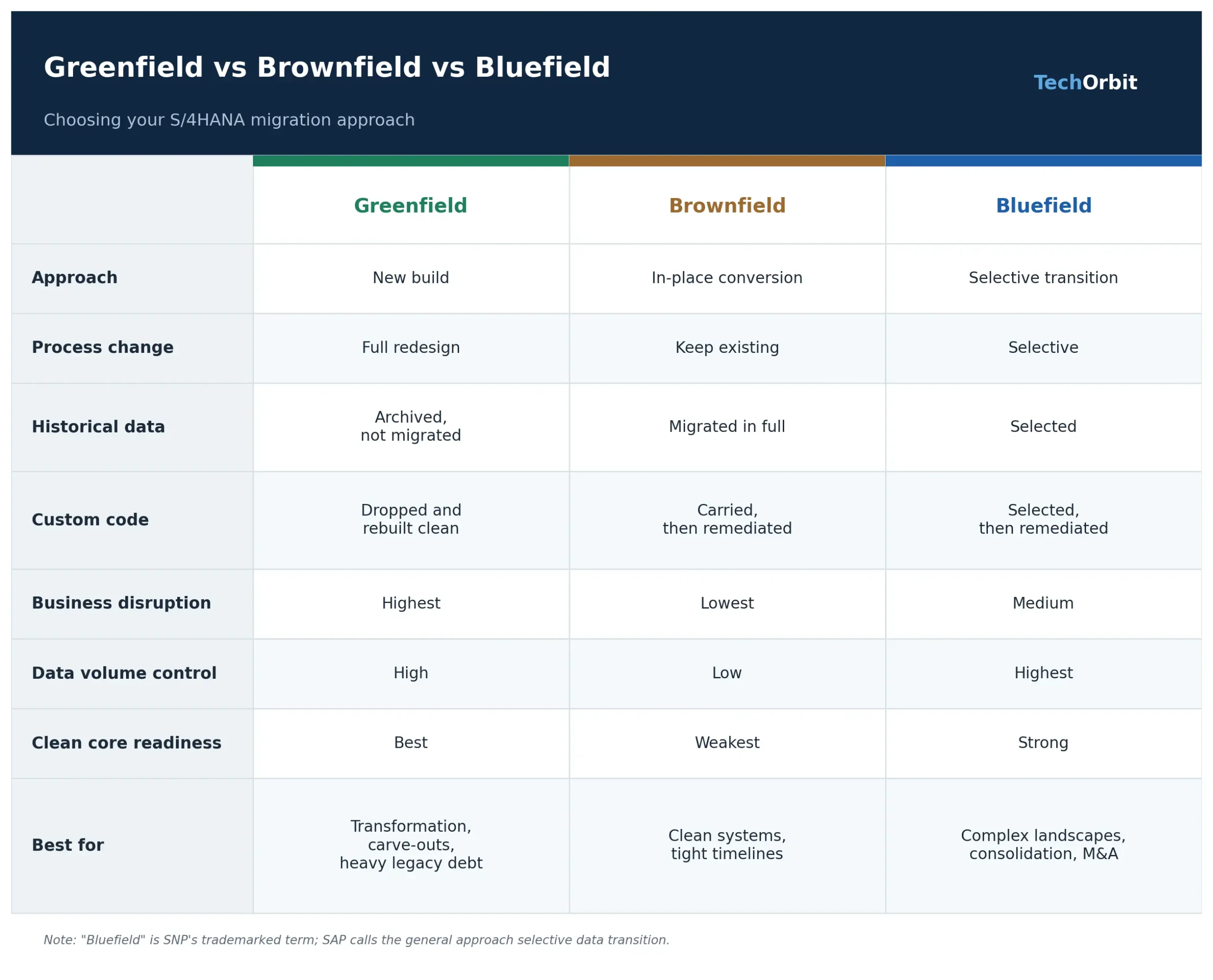
Greenfield vs Brownfield vs Bluefield
So which one is right for you?
Strip away the labels and the decision comes down to three questions.
First, how much of your current system is worth keeping? If the answer is “very little,” lean greenfield. If “most of it,” lean brownfield. If “some of it, and we would choose carefully,” that is bluefield.
Second, how much change can your organization absorb in the time you have? Greenfield demands the most, brownfield the least. The 2027 deadline shrinks the runway for everyone, which is why the honest answer for many heavily customized enterprises is bluefield: more transformation than brownfield allows, less organizational shock than greenfield forces.
Third, how much data are you about to move, and how much of it is junk? It sets your HANA licensing tier, your infrastructure cost, your timeline, and your risk. Find it first schedule a meeting for Data assessment
That is the reframe that matters. Greenfield, brownfield, and bluefield are usually described as technical or process choices. They are data choices wearing technical labels. Greenfield is a decision about what to leave behind and archive. Brownfield is a decision about how much unnecessary data you are willing to carry. Bluefield is a decision about what to select. Get the data strategy right and any of the three can land on budget.
Where to start
The most useful first step is a data assessment: how much you have, how much is redundant, and what each approach would cost you in HANA licensing and timeline. That number usually decides the approach for you.
TechOrbit’s deepest practice is SAP data management & S/4HANA Implementation: data volume management, archiving, ILM, carve-outs, and decommissioning. That is the exact discipline that decides whether a migration lands on budget, whatever path you choose.
If you are weighing greenfield, brownfield, or bluefield, start with the data. We can model it for you; Book an S/4HANA data assessment with TechOrbit’s SAP team.
