
SAP application management services (AMS) is the ongoing support, monitoring, and optimisation of your SAP landscape by an external partner across L1, L2, and L3 tiers. You should move from in-house support to a managed model when the specific senior skills your SAP system now needs are scarcer than your team can hire, retain, or justify keeping on payroll for a run function. For most mid-market SAP teams in 2026, that point has already arrived.
Most companies get the framing wrong, so they make the call two years late and pay for it in downtime, key-person risk, and a support team that knows the old system better than the new one.
This guide gives you a straight decision framework: what AMS actually covers, the honest trade-off against in-house, seven signals that it is time to switch, and the one thing that separates AMS that saves money from AMS that just closes tickets.
What SAP application management services actually cover: L1, L2, L3
Buyers conflate “support” with “the help desk.” A managed AMS engagement is tiered, and the tiers matter because they map to very different skills and costs.
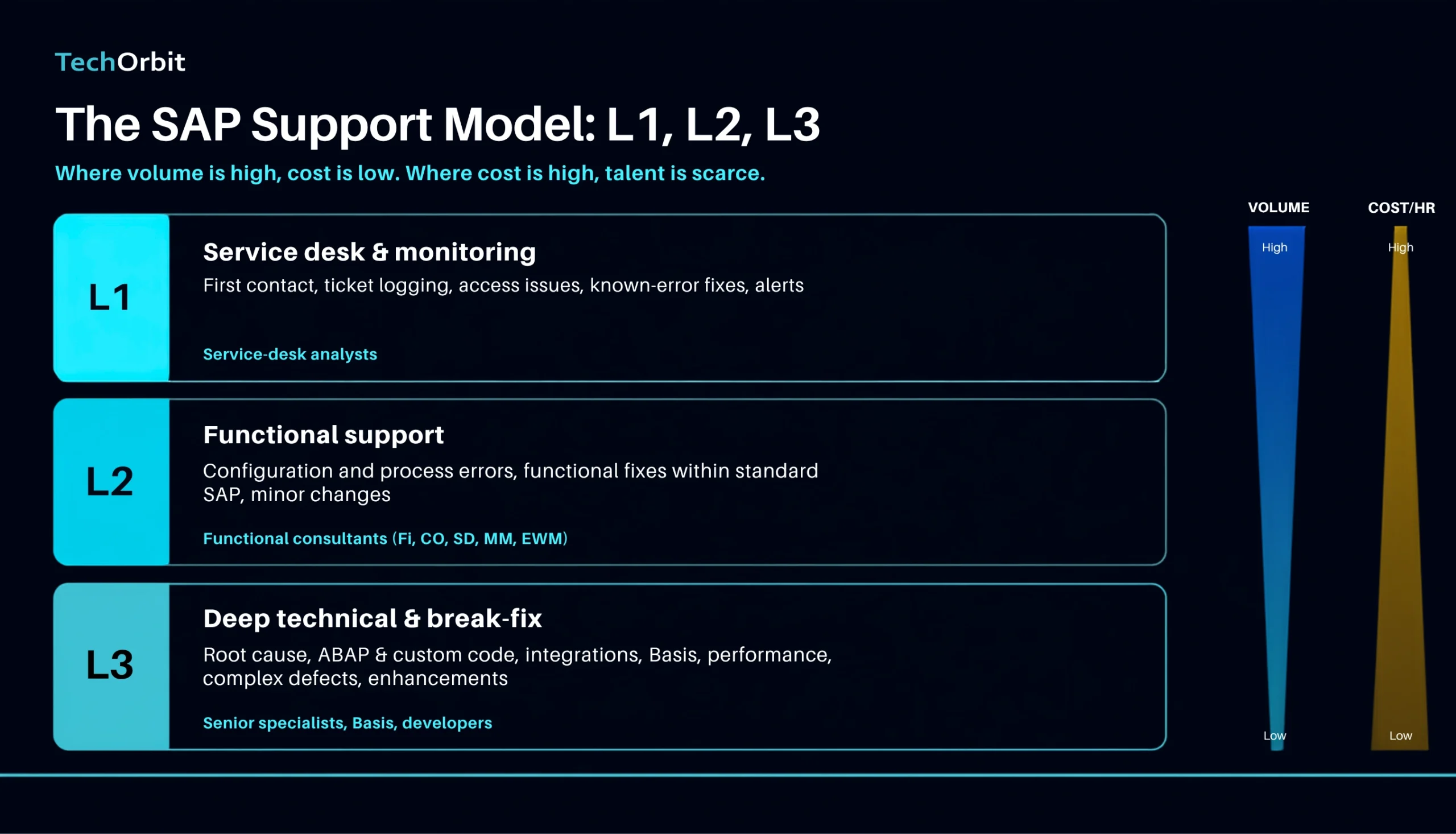
The economics sit in that table. L1 is high-volume and low-cost. L3 is low-volume and expensive. When you run support in-house, you carry L3 specialists full-time to cover incidents that occur a few times a quarter. You are paying peak-load rates for capacity you use a fraction of the time. A managed model lets you buy L3 depth on demand and pay volume rates for L1.
In-house vs managed SAP support: the honest trade-off
SAP application management services are not universally the right answer, and neither is in-house. Here is the trade-off without the sales gloss.
In-house wins on business context and control. Managed wins on skills access, risk, coverage, and cost flexibility. For most mid-market SAP estates, the pragmatic answer is not one or the other. It is a hybrid: keep a thin internal core that owns business context, governance, and vendor management, and put run operations and specialist depth on AMS. More on that below.
The decision framework: 7 signals it is time to move to AMS
Use this as a scoring checklist. If three or more of these are true, a managed model almost certainly beats in-house on cost, risk, or both.
- You have gone live on S/4HANA and the support job changed shape. Quarterly cloud releases and Clean Core mean your team is maintaining a moving target, not a fixed one. In-house skill decay is now a live risk.
- You are running ECC and S/4HANA in parallel. Dual-run doubles the surface area your support team covers, usually with the same headcount. Something gives, and it is normally the new system.
- A single resignation would expose you. If one Basis lead, one FICO consultant, or one integration specialist leaving would create a real operational gap, your key-person risk is already too high.
- Senior people spend their week on L1 and L2 tickets. When your most expensive consultants are resetting access and clearing routine errors, you are paying architect rates for help-desk work and starving your improvement roadmap.
- You cannot cover the hours the business runs. Multi-shift operations, multiple geographies, or month-end and season peaks that your in-house team cannot staff around the clock.
- Hiring takes 90-plus days and you lose candidates to counter-offers. If the talent market is beating you on speed and rate, buying the capability is faster and cheaper than building it.
- Your support cost is unpredictable and rising. Overtime, contractor top-ups during peaks, and re-hiring after churn make in-house cost lumpy. A banded AMS contract makes it forecastable.
They are about matching the shape of your support to the shape of a modern, moving SAP landscape.
SAP AMS pricing models, and when each fits
AMS pricing is where buyers get caught out, because providers price four different ways and they suit different situations.
- Ticket or incident-based. You pay per resolved ticket or per band of volume. Fits stable landscapes with predictable, reactive support needs. Watch that it does not disincentivise root-cause fixes.
- FTE or capacity-based. You buy a defined team of named roles. Fits complex estates that need dedicated, deep knowledge and a steady change pipeline. Most predictable, less elastic.
- Time and materials. You pay for hours consumed. Fits variable or project-heavy periods. Least predictable, so it works best as a top-up to a fixed base.
- Outcome or SLA-based. You pay against service levels and business outcomes, not effort. Fits mature buyers who can define outcomes and want the provider carrying delivery risk.
Most sound engagements blend a fixed base band for run operations with a T&M or capacity buffer for enhancements. The right question is not “which is cheapest per hour.” It is “which model matches how variable my support demand actually is.
How to actually decide
Lead with the recommendation. For most mid-market SAP estates in 2026, the right structure is a hybrid: a thin internal core that owns business context, data governance, and vendor management, with run operations and L2-L3 specialist depth delivered through SAP application management services. Full in-house is defensible only if you can reliably hire and retain scarce senior SAP talent for a run function, which most organisations now cannot. Full outsourcing without an internal owner is a governance risk.
Score your situation against the seven signals. Model the true in-house cost, including key-person risk, coverage gaps, and the senior time lost to L1 work, not just salaries. Then ask any prospective partner the question that matters most: does your AMS lower our run-cost over time, or just hold it flat? If they cannot answer with data volume, archiving, and decommissioning, they are selling ticket-closing.
Frequently asked questions
What are SAP application management services?
SAP application management services are the ongoing support, monitoring, and optimisation of an SAP landscape delivered by an external partner across L1, L2, and L3 tiers. The scope covers help-desk and monitoring, functional and configuration fixes, and senior technical work such as ABAP, Basis, integrations, and performance, plus small enhancements.
When should we move from in-house SAP support to AMS?
Move when the senior skills your landscape needs are harder to hire and retain than to buy on demand. Practical signals include an S/4HANA go-live that changed the support job, running ECC and S/4HANA in parallel, high key-person risk, senior staff stuck on L1 tickets, coverage gaps, 90-plus-day hiring cycles, and unpredictable rising support cost. Three or more of these usually means AMS wins.
What is the difference between L1, L2, and L3 SAP support?
L1 handles first contact, monitoring, and known-error resolution. L2 handles configuration and functional fixes within standard SAP. L3 handles root-cause work: custom code, ABAP, integrations, Basis, performance, and complex break-fix. L3 is the lowest-volume and highest-cost tier, and the one where the talent shortage is most acute.
How is SAP AMS priced?
Common models are ticket or incident-based, FTE or capacity-based, time and materials, and outcome or SLA-based. Most engagements blend a fixed base band for run operations with a variable buffer for enhancements. The right model depends on how variable your support demand is.
Does moving to AMS mean losing control of our SAP system?
No, if the model is structured well. The recommended approach is a hybrid: keep a thin internal core that owns governance, data, and vendor management, and delegate run operations and specialist depth to the partner. Control stays in-house; execution and scarce skills come from AMS.
