


Auto suppliers work inside a tight squeeze. OEMs expect annual cost-downs, zero-defect quality and on-time sequenced delivery. Steel, aluminium and copper prices move every quarter. A single line-stop at the customer can wipe out a month of profit on that part number.
SAP for automotive suppliers solves seven specific problems: volatile OEM schedules, variant-heavy BOMs, IATF 16949 traceability, invisible stock at job workers, retrospective price revisions, buyer demands for carbon data, and ageing ECC systems. Each one leaks margin quietly. Most Indian component makers are carrying all seven at once.
When the ERP cannot keep pace, the gap fills with spreadsheets. The planner keeps one, the quality head keeps another and finance keeps a third. The ERP ends up recording decisions made somewhere else, and leadership loses the single view it needs to act on cost, delivery and risk.
7 Problems SAP for Automotive Manufacturers Is Built to Solve
The map below summarises each problem, how it shows up on the shop floor, and the SAP for automotive capability that closes it. The detail follows.
1. Raw material price revisions leak margin
Most OEM contracts index steel, aluminium, copper or rubber prices and revise them quarterly with retrospective effect. Suppliers then have to raise supplementary invoices on months of dispatches. Every missed invoice is margin written off.
How SAP for automotive fixes it. Customer prices sit in condition records with validity dates. When a revision is approved, retroactive billing finds every invoice raised at the old price and generates the difference automatically. On the buying side, the Universal Journal shows material price variance in real time, so finance sees the squeeze before month-end.
4. OEM schedules change faster than your production plan
OEMs send forecast delivery schedules and JIT call-offs over EDI, often daily. When planners reconcile these by hand, the result is premium freight, unplanned overtime, bloated safety stock and debit notes for short supply.
How SAP for automotive fixes it. SAP S/4HANA scheduling agreements take forecast and JIT schedules straight from EDI (DELFOR and DELJIT messages) and flag abnormal jumps against tolerance limits. MRP Live replans in minutes on SAP HANA. Predictive MRP simulates capacity against the medium-term forecast before you commit to a second shift, and JIT supply to customer handles sequenced delivery to the assembly line.
3. Variants and engineering changes outrun the BOM
One platform can now carry ICE, CNG, hybrid and EV variants, plus export specifications. OEM engineering change notes arrive constantly. If the plant builds against an old revision, you pay for scrap, rework and a fresh PPAP submission.
How SAP for automotive fixes it. Advanced Variant Configuration models every variant from one configurable material. Change records carry effectivity dates, so a new revision goes live on a set date and old-revision stock is used up first. Product costing by variant shows which variants actually make money, which matters when an OEM asks you to quote on an EV programme.
4. Job workers and Tier-2 suppliers are a blind spot
Components go out for plating, heat treatment and machining. Stock sits at the vendor with no live view, job-work records for GST reporting are rebuilt at period end, and trucks queue at the gate without advance shipping notices.
How SAP for automotive fixes it. Subcontracting in SAP S/4HANA tracks material at the vendor as a separate stock type, so you always know what is where. TechOrbit Supply360, built on SAP BTP, gives suppliers a portal for ASN creation, gate entry, quality checks and shipment tracking, integrated with S/4HANA.
5. Buyers now want carbon data at part level
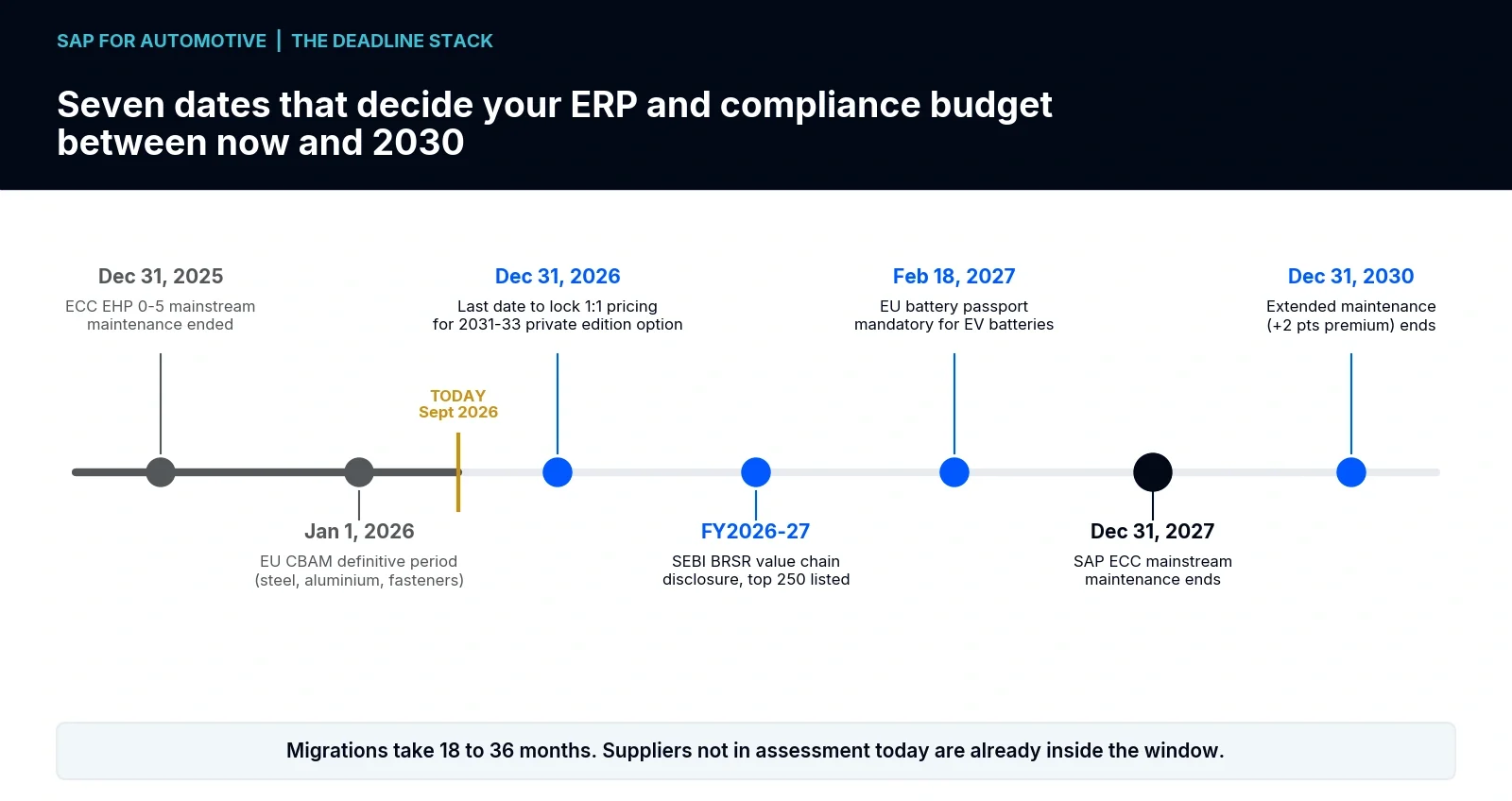
Three rules are pushing this down the supply chain. SEBI’s BRSR value chain disclosures for the top 250 listed companies apply from FY2026-27, so large OEMs will ask their suppliers for ESG data. The EU Carbon Border Adjustment Mechanism has been in its definitive period since January 1, 2026, and covers iron, steel and aluminium goods, including fasteners. The EU battery passport under Regulation (EU) 2023/1542 becomes mandatory for EV batteries on February 18, 2027, and European importers will pass those data requests back to suppliers.
How SAP for automotive fixes it. SAP Sustainability Footprint Management calculates product carbon footprints from the BOMs, routings and purchase data already in your ERP. The numbers come from the same transactions finance reports on, which makes them far easier to defend when a buyer or auditor asks.
6. IATF 16949 traceability still runs on paper
A customer complaint arrives. You need to know which heat of steel, which machine, which shift and which dispatch are involved. With paper route cards, that takes days, and the containment scope grows while you search. The next IATF 16949 revision, expected in late 2026 or early 2027, is set to put more weight on supply chain traceability and cybersecurity.
How SAP for automotive fixes it. SAP Quality Management creates inspection lots at goods receipt, in process and at final inspection. Batch management gives a forward and backward where-used view in one screen, and quality notifications structure the 8D response. The TechOrbit Barcode Solution captures batch identity at each shop-floor transaction, so traceability data is recorded as the work happens instead of keyed in later.
6. ECC is running out of runway, and your data is heavy
SAP ECC mainstream maintenance ends on December 31, 2027, per SAP’s published maintenance commitment. Extended maintenance to 2030 costs an extra two percentage points. Customers on EHP 0 to 5 have been on customer-specific maintenance since January 2026, with no new legal or security updates. Migrations take 18 to 36 months, so a supplier starting in 2027 is already late.
Automotive suppliers carry a hidden cost into that migration: data volume. Years of schedule lines, delivery documents, change documents and EDI IDocs often make up a large share of a typical auto supplier’s database. SAP HANA is licensed in step increments, so migrating that history can push you into a larger licence tier and a longer cutover.
How SAP for automotive fixes it. Archive before you migrate. SAP data archiving with ILM retention rules moves closed history out of the live database while keeping it available for audit. You then move a smaller system to SAP S/4HANA, or to GROW with SAP for mid-market plants that can run on standard processes. Every terabyte removed lowers infrastructure cost, licence sizing and cutover time.
Where to Start with SAP for Automotive: The Sequence We Recommend
- Measure the data first. Run a data volume assessment and agree an archiving plan before anyone sizes HANA.
- Choose the deployment on fit. GROW with SAP suits mid-market suppliers with standard processes and a need for speed. RISE with SAP private edition suits multi-plant groups with heavy EDI and custom logic. Complex estates should note that the pricing lock for the 2031 to 2033 private edition transition option closes at the end of 2026.
- Go live with the OEM-facing processes. Scheduling agreements, QM with batch management and subcontracting deliver the fastest payback.
- Add sustainability and analytics in phase two, once the transactional data is clean.
SAP consultant rates are expected to rise 30 to 50% through 2027 as demand outpaces supply. Suppliers who start late will pay more for less experienced teams.
Proof: An SAP for Automotive Go-Live in Four Months
GNA Axles, an automotive axle and shaft manufacturer, went live on GROW with SAP in four months with TechOrbit. It is one of 14 TechOrbit SAP go-lives delivered in three to five months.
That speed comes from senior-led teams, a dedicated SAP data management practice that shrinks the system before migration, and ready IP for supplier collaboration and barcode traceability. TechOrbit is an SAP Gold Partner with 300+ consultants and 25+ S/4HANA projects, appraised at CMMI Level 5 and certified to ISO 27001 and SOC 2. See our automotive manufacturing practice and SAP migration services for more.
Fix the Problem with TechOrbit
Every automotive supplier’s list is different. For one it is retro pricing, for another it is recall exposure or a 2027 deadline with 2 TB of history. The right SAP for automotive roadmap starts with knowing which problem is costing you most.
Book an Assessment with a TechOrbit senior consultant. We will review your data volume, ECC timeline and plant processes, and show you the fastest safe route to S/4HANA.